Concrete Contractor in Union Grove, WI
Residential and commercial concrete throughout Union Grove — driveways, patios, stamped work, slabs, walks, steps and repair. Every estimate breaks out tear-out, base depth and reinforcement, so three bids can be read side by side.
Racine Premier Concrete is your local resource for concrete driveways, patios, sidewalks, steps, slabs, foundations and repair throughout Union Grove, WI. We work with experienced concrete contractors who write estimates a homeowner can actually compare.
Union Grove has been a settlement since 1838, which means the village core holds flatwork poured across nearly two centuries of changing practice, and almost none of it to the standard that applies now. Walks cracked on lines nobody planned, stoops sitting on shallow fill, and driveways thin enough that patching them is buying a season — that is the majority of the residential work here.
Around the core, the village is surrounded by working farmland, and that changes the other half of the job. Approach drives run long, pads carry equipment rather than cars, and the loads that matter are point loads from a tractor tire or a trailer tongue rather than the weight of a parked sedan. Those are two different specifications, and a concrete company that quotes them the same way is guessing on one of them.
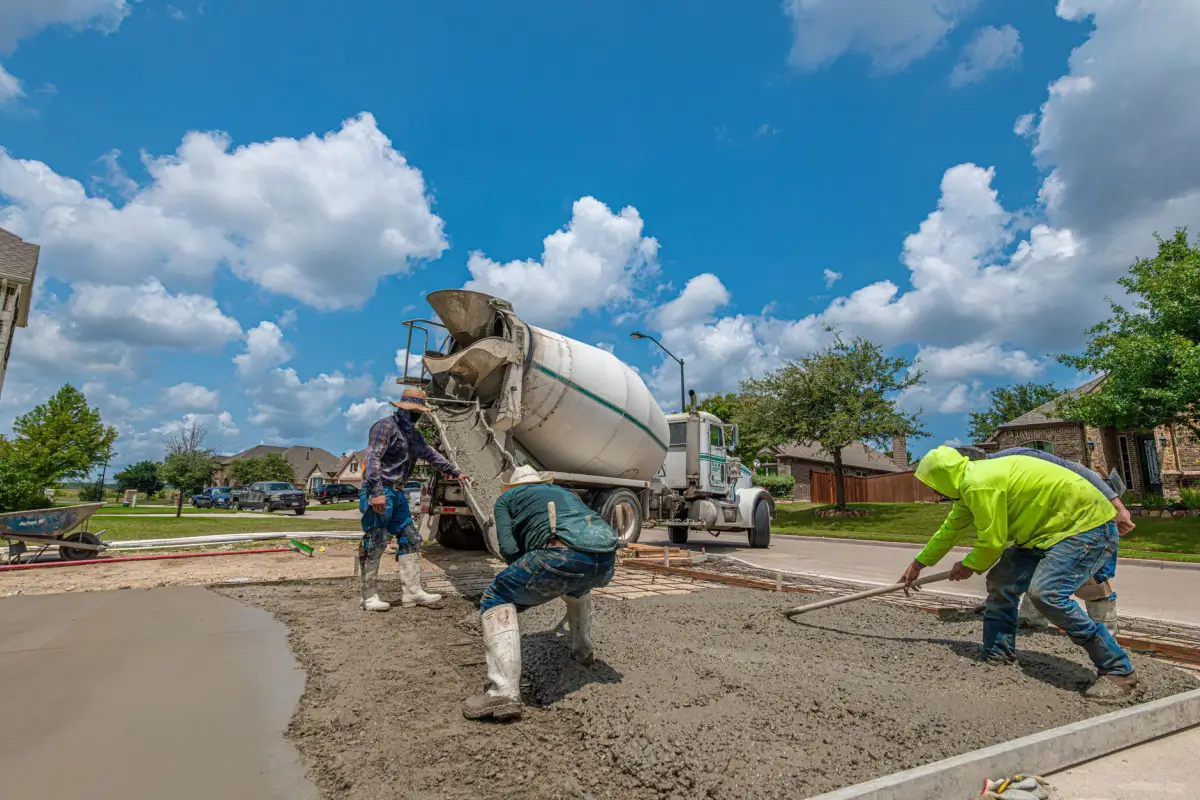
Concrete Services in Union Grove, WI
Residential and commercial concrete across Union Grove. Each estimate names thickness, base depth and reinforcement as separate line items, which is what makes two bids comparable in the first place.
Concrete Driveways
New pours, full replacements, extensions and widening. Four inches is walkway spec; where a vehicle parks or turns it is five to six inches, and six with #4 rebar on chairs at 18 inches on center where an RV, a boat trailer or a delivery truck sits. Under all of it goes four inches of compacted dense-graded base as the working minimum, deeper where excavation turns up a soft pocket. The apron at the street is usually the municipality's call rather than yours, so the right-of-way requirement gets confirmed before anyone orders concrete. A long approach drive crosses more variable subgrade than a village driveway does, which is where #4 rebar earns its place over fiber alone.
Concrete Patios
Backyard slabs, patio replacements and extensions sized to the furniture that actually goes on them. Four inches over compacted base handles foot traffic and a grill. The two decisions worth arguing about are joint layout, which should be drawn before the pour rather than cut wherever the saw lands the next morning, and pitch — a quarter inch per foot away from the house keeps water off the siding and out of the basement instead of ponding at the door. Village lots here generally have real truck access to the back yard, which keeps a patio pour simpler than the same job on a tight city lot.
Stamped Concrete
Pattern, release color and sealer are chosen at the estimate, not on placement day, because the window to stamp a slab closes in under an hour once the concrete goes plastic. That is why stamped work is priced and scheduled differently from a broom finish: it needs more hands on site at the same moment. A stamped border around a broom-finished field is the common compromise on a large driveway. Sealer is maintenance, and it has to be reapplied. Stamped patios and entry landings suit these frontages, and the pattern and release color get locked in at the estimate rather than on placement day.
Concrete Slabs
Garage slabs, shed and outbuilding pads, addition slabs, hot tub pads and equipment pads. Thickness follows the load the slab actually carries rather than a default four inches on every job, and a pad under a hot tub or a lift is a different spec from a pad under a garden shed. Anything under a conditioned space gets a vapor retarder under the slab. Anything carrying a point load gets steel, sized and placed on chairs so it sits inside the slab. Machine sheds, pole barns and equipment pads are routine here, and each one gets sized to the load that actually sits on it.
Concrete Sidewalks & Walkways
Front walks, garden paths, service walks and replacement of heaved or cracked panels along the terrace. Four inches is standard, six where a walk crosses a driveway and takes vehicle weight. Work in the public right-of-way follows the municipality's own spec, permit and inspection process, which is a real line item and a real scheduling constraint — not something to discover after the forms are set. The village core has public walks and its own right-of-way process; parcels outside it usually do not, so the permit answer depends on the address.
Concrete Steps
Front entry steps, porch and patio steps, and replacement of a flight that has settled away from the house. This is the one item on the list that is a footing job rather than a flatwork job: Wisconsin's Uniform Dwelling Code, SPS 321.16(1)(a), puts footings below frost penetration or at least 48 inches below adjacent grade, whichever is deeper, and that includes landings and stoops. Steps that have pulled away from a house almost always sat on something shallower than that. Stoops on the oldest housing stock in the village were poured on shallow fill, which is why the flight has walked away from the porch.
Concrete Repair
Crack repair, spalling and scaling repair, panel replacement, and a straight answer about which slabs are worth repairing at all. A hairline crack with both sides level is shrinkage and stays that way. A crack wider than about a quarter inch with one side sitting higher is the base underneath telling you it moved, and sealing it buys a season. Surface flaking after a few winters is a salt story, and resurfacing fixes the appearance without fixing anything structural. An unjointed nineteenth-century walk has already picked its crack lines, and panel replacement resets it in a way sealing cannot.
Residential Concrete
Driveways, patios, walks, steps, garage floors, slabs, foundations, resurfacing and removal for houses, duplexes and condominium associations. Residential work is scheduled around the fact that people live there: one driveway means one vehicle parked on the street for a week, and a walk replacement means a route to the front door that still works while the concrete cures. Most village lots have somewhere for a ready-mix truck to sit, which keeps pump charges off the majority of residential estimates here.
Commercial Concrete
Flatwork, parking lots, loading and delivery areas, sidewalks, dumpster pads and structural slabs for retail, office, industrial and multi-family properties. Drive lanes and trash-truck routes get thicker sections than the stalls beside them. Scope and phasing get priced up front, including night and weekend work, because a closed entrance costs a tenant more in a day than the concrete does. Along the Durand Avenue frontage the lot work is phased so businesses keep an entrance open through the job.
Our Concrete Process for Union Grove Properties
- 1
Site Visit, Measurement and a Written Estimate
The first visit establishes square footage, how thick the existing slab is where a broken edge shows it, where water currently goes, and whether a ready-mix truck can physically reach the forms. Access is not a footnote. A truck that backs to the forms is one price; a backyard patio past a fence, a slab behind a garage with no side yard, or a lot on a rise is a pump or a line pump and a separate line item. The estimate that comes back should name square footage, thickness, base depth, reinforcement, whether tear-out and haul-off are included, and what happens to the lawn afterward. Anything missing from that list is a question worth asking before you sign, including on the two bids that did not come from here. On a farm-edge parcel the site visit starts with what parks on the pad, because the loading sets the thickness before anything else.
- 2
Permits, Utility Locates and Scheduling
Anything in the public terrace, an apron where a driveway meets the street, and most sidewalk panels along a right-of-way are the municipality's jurisdiction, with their own spec sheet, permit and inspection hold. That gets confirmed with the building or engineering department before concrete is ordered rather than after. Utility locates go through Diggers Hotline, Wisconsin's 811 center, and the free locate has to be requested at least three working days ahead — which is one of the real reasons a start date sits a week out rather than tomorrow. Scheduling also has to respect the ground: saturated clay subgrade will not compact, and in a wet spring the honest answer is sometimes to wait rather than force base course over mud.
- 3
Tear-Out and Haul-Off
Old concrete is broken out, loaded and hauled away, and the volume of that debris drives the number rather than the surface area on top of it. Four inches with nothing in it loads out fast. Six inches with rebar through it takes longer, fills more trucks and costs more to dump. This is also the step that finally exposes the ground that caused the original failure, which is why replacement estimates should be read as demolition-and-disposal jobs with a pour at the end. A bid that folds tear-out into a single lump sum is hiding the one variable most likely to change on site. In the old village core the slabs break out fast with no steel in them, which keeps the disposal line reasonable on a replacement.
- 4
Subgrade, Base Course and Forming
With the old slab gone, soft spots and old utility trenches get dug out and replaced instead of bridged over. Dense-graded base course goes in and gets compacted in lifts rather than one deep layer, because a plate compactor only works through so much material at a time. Four inches compacted is the working residential minimum here, and slow-draining clay subgrade earns more. Forms then set the finished elevation and the fall, so water runs away from the garage, the foundation and the front door rather than toward them. Grade stakes confirm the slope rather than eyeballing it off the existing slab, which may well have been the problem.
- 5
Placement, Finish, Joints and Cure
Concrete arrives at a specified strength and air content — typically 4,000 psi with air entrainment for exterior exposure in Wisconsin, because entrained air gives freezing water somewhere to go instead of pushing the surface off. Water added at the truck to make placement easier reduces the strength of what actually gets poured. Placement runs screed, bull float, edge, then a wait for bleed water to leave before final finishing; finishing early traps that water and is a common cause of a surface that scales two winters later. Broom finish is the default because it holds traction on a surface that spends four months wet, frozen or salted. Control joints are saw-cut within the first day at roughly a quarter of the slab depth, then curing compound goes on.
The Cheapest Bid Usually Has the Same Square Footage and Half the Base
A phone number and a truck in the driveway don't make a concrete company. Here's what to check on every estimate you're holding for a job in Union Grove, WI, including the ones that didn't come from here.
An Estimate That States Thickness
Four inches and six inches are different jobs at different prices. A quote that does not say which one it is selling cannot be compared to anything else on the table.
Base Depth in Writing
Base is the part nobody sees and the part that decides whether the slab is still flat in ten years. Ask how deep the compacted base course goes, and what happens if the excavation turns up soft subgrade.
Tear-Out Priced Separately
Demolition and haul-off is a real cost with its own variables, driven by the volume of old concrete rather than the square footage on top of it. Seeing it as its own line item means somebody actually estimated it.
A Joint Plan Before the Pour
Control joint spacing and timing should be settled before concrete is ordered, not improvised with a saw the next morning. Ask where the joints will fall and when they get cut.
A Straight Answer on Access
If a ready-mix truck cannot reach the forms, somebody is paying for a pump or a line pump. Better to hear that at the estimate than on placement day.
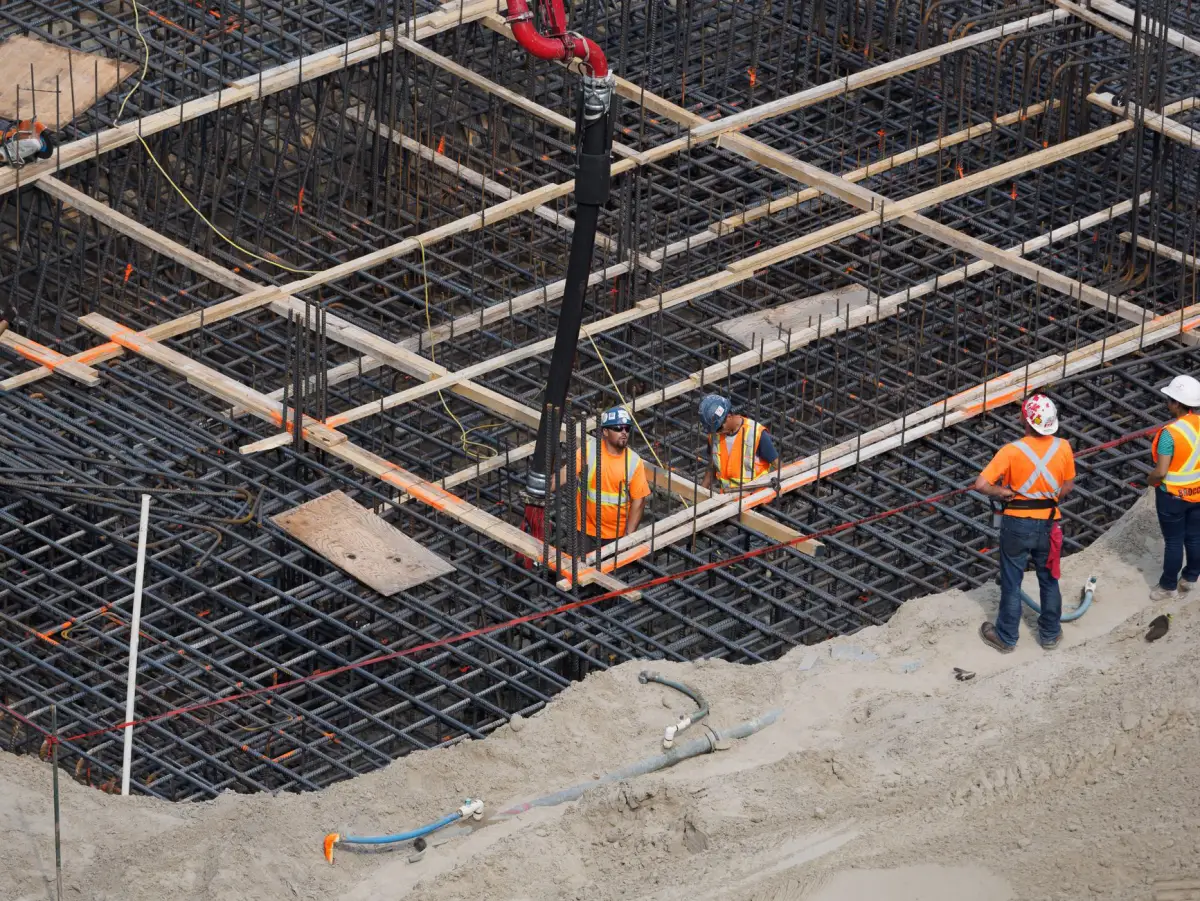
What Concrete Work Looks Like in Union Grove, WI
Durand Avenue and the Fairgrounds Frontage
The Racine County Fairgrounds sits on Durand Avenue — Highway 11 — at the edge of the village, and event ground is its own concrete problem. Overflow parking, vendor areas and service lanes take heavy, concentrated traffic in short bursts and then sit unused, which is a different loading pattern from a lot used steadily all year. Entrance aprons and service routes take truck and trailer traffic and get poured thicker than the areas beside them. Work on a site like that is also scheduled hard against the event calendar rather than the weather window.
A Village Core Platted in 1838
The oldest built ground in Union Grove predates saw-cut control joints, air-entrained mix and the 48-inch footing requirement, and it fails in all three of the ways you would expect. Walks crack on lines the slab chose rather than lines somebody planned. Surfaces scale after decades of de-icing salt. Stoops separate from houses because their footings never reached frost depth. Each of those has a different honest answer, and replacement work here is priced as demolition and disposal with a pour at the end rather than the other way around.
School and Campus Flatwork
For a village this size Union Grove carries an unusual amount of school ground — an elementary school, a union high school and other campuses — and campus flatwork has its own constraints. Accessible routes, curb ramps and entrance landings are scoped explicitly rather than assumed, because a rebuilt entrance that misses slope tolerance gets rebuilt twice. The work window is the academic calendar: a walk replacement that would take a week anywhere else gets planned into a summer break so a route to every door stays open when students return.
Farm-Edge Parcels and Equipment Pads
Just outside the village the parcels turn agricultural, and the concrete follows. Machine shed floors, grain and equipment pads, and aprons in front of large doors get specified against point loads — a tractor tire, a loader set down, a loaded trailer resting on its tongue jack — rather than against square footage. That normally means a thicker section with #4 rebar on chairs instead of fiber in the mix, and joint spacing planned around the door openings and column lines rather than dropped onto a uniform grid.
Around Union Grove, WI
Named for a Grove of Burr Oak
Governor Henry Dodge named the place by combining Union with Grove, after the stand of burr oak on the west side of the land. The settlement dates to 1838, which makes it older than most of the municipalities around it.
Shepherds College
A post-secondary school for students with intellectual disabilities operates here — an unusual institution for a village this size, and part of why Union Grove supports more campus ground than its population suggests.
When We’re Not the Right Call
- Union Grove is 12.7 miles west-southwest of Racine, an ordinary working distance for a full project. It is not a sensible distance for one cracked panel: the drive and a ready-mix short-load charge together cost more than the concrete, so isolated repairs are better grouped into one visit.
- If the slab is structurally sound and the real issue is a few hairline cracks with both sides sitting level, that is a crack-sealing job, not a replacement, and it costs a fraction of a pour.
- A patch smaller than a ready-mix truck's minimum load is an awkward job for everybody. The short-load charge can approach the cost of the concrete itself, so small isolated repairs are usually better bundled with other work rather than booked on their own.
- If you are set on pavers, pavers are a legitimate choice and this is the wrong site. They handle frost movement by being individually resettable, and no amount of concrete argument changes that.
- If the budget covers the concrete but not the tear-out and haul-off underneath it, the project is not ready. Pouring over a failed slab to save the demolition line item is how a driveway fails twice.
- If the ask is a January pour, the honest answer is to wait for spring. Cold-weather concreting works with blankets, heated enclosures and mix adjustments, but on residential flatwork it adds cost and risk for no benefit.
Frequently Asked Questions
- Do you serve Union Grove, WI?
- Yes. Union Grove is 12.7 miles west-southwest of Racine, straight out Durand Avenue, and the village and the parcels around it are inside the regular working area. Residential, agricultural and commercial work all get quoted the same way.
- How thick does a machine shed or equipment pad need to be?
- Thicker than a driveway, and reinforced differently. What governs is the point load rather than the total weight — a tractor tire, a loader bucket set down, or a loaded trailer resting on its tongue jack concentrates force on a small contact area, and that is what punches through an underspecified slab. Typically that means a thicker section with #4 rebar on chairs at 18 inches on center rather than fiber, plus joint layout planned around the door openings.
- Do I need a permit in Union Grove?
- It depends where the work sits. Terrace sidewalk panels and the apron where a driveway meets a village street are right-of-way work and go through the village, with its own specification and inspection. Parcels outside the village boundary generally have no public walk and no terrace involved, so the same job carries no right-of-way permit. That gets confirmed before concrete is ordered rather than assumed either way.
- Why do the old sidewalks in the village crack in random places?
- Because they were poured before control joints were cut on a defined schedule. Concrete shrinks as it cures and will crack somewhere; a joint grid is how you choose where. Without one, the slab picks its own lines and keeps working along them for the rest of its life. Replacing full panels and cutting joints at roughly a quarter of the slab depth, spaced to the thickness, is what resets it.
- What does concrete work cost in Union Grove?
- Square footage, thickness, base depth, reinforcement, tear-out volume and access. On agricultural work the loading specification is the biggest variable, because a pad designed for a car and a pad designed for a loader are not the same product. Estimates are free and on-site.
Learn More
- Wisconsin Uniform Dwelling Code, SPS 321 — SPS 321.16(1)(a) is the 48-inch frost-depth requirement cited on this page for footings under steps, stoops and landings.
- American Concrete Institute — Publishes ACI 302 and ACI 332, the guides behind the joint spacing, slab thickness and curing practices described above.
- Diggers Hotline (Wisconsin 811) — Wisconsin's free utility locate service. Locates are requested at least three working days before excavation, which is part of why a start date sits a week out.
Concrete Contractors in Nearby Cities
Same estimate format across Racine, Kenosha, Milwaukee & Waukesha Counties and the towns just west of them.
- Concrete Contractor in Kenosha, WI
- Concrete Contractor in Oak Creek, WI
- Concrete Contractor in Mount Pleasant, WI
- Concrete Contractor in Caledonia, WI
- Concrete Contractor in Franklin, WI
- Concrete Contractor in Muskego, WI
- Concrete Contractor in Pleasant Prairie, WI
- Concrete Contractor in South Milwaukee, WI
- Concrete Contractor in Cudahy, WI
- Concrete Contractor in Burlington, WI
- Concrete Contractor in Sturtevant, WI
- Concrete Contractor in Waterford, WI
- Concrete Contractor in Wind Lake, WI
- Concrete Contractor in Yorkville, WI
Looking for a Concrete Contractor in Union Grove, WI?
Describe the driveway, the patio or the lot and get an immediate on-site quote — no charge for the estimate, and no obligation to book it.
Get My Free Estimate